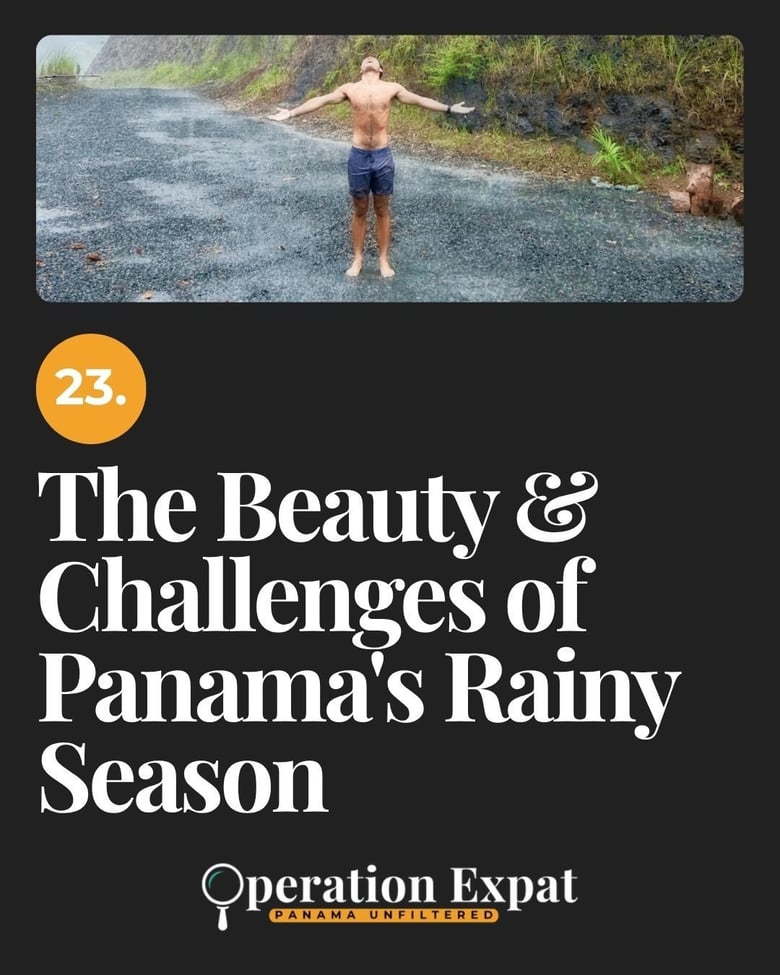
23. The Beauty & Challenges of Panama's Rainy Season
The Beauty & Challenges of Panama's Rainy Season
It once intimidated me. Now it's my hands-down favorite time of year. A look at the renewal, the bugs, the mud—and the soul-deep beauty of the rains.
Somewhere around the middle of April, nature starts dropping subtle hints that rain and lushness are returning to Panama.
A certain cicada starts calling...the winds begin to subside...brief flashes of lightning flicker over the ocean.
Much like its dry counterpart, the rainy season brings its own set of delights and challenges. Prior to living here, the rainy season intimidated me...now that I live here, it's my hands down favorite time of year.
A time of renewal... 🍃
In Panama, the onset of the rain breathes new life into the landscape. The parched brown earth soaks up the moisture and, faster than you'd ever believe possible, the vibrant green returns.
The rainy season impacts the entire country, however the northern Caribbean side gets much more rain than we do on the Azuero Peninsula on the opposite side.
When is the rainy season?
Panama's rainy season usually spans from May to December, with the heaviest rains falling between September and November. However, this can vary by a month-ish depending upon whether it's an El Niño or La Niña year.
Local wisdom says when the Guayacán trees burst out in bright yellow flowers, the rain will arrive within 30 days.
During El Niño years, warmer ocean temps in the equatorial Pacific trigger drier-than-normal conditions, decreasing the span of the rainy season and the total amount of rain.
The rainy season in 2023 was impacted by El Niño ~ we got so little rain that the Panama canal suffered during the dry season that followed and many areas ran out of water.
In contrast, La Niña brings cooler ocean temps resulting in increased rainfall and a longer rainy season.
In the Azuero's Dry Arc, where we live, the rain is generally sporadic ~ typically coming in short, moderate to heavy bursts. Some days there won't be rain at all.
Across the country, rivers swell, waterfalls that disappeared or shrunk during the dry season return to their former glory and the jungle becomes lush once again.
Weathering the storms...
With the increase in rainfall comes a rise in humidity levels, creating a stickier and slightly more uncomfortable atmosphere.
With the humidity come two of my least favorite aspects of the rainy season:
- Bugs
- Mold/mildew
With the first consistent rains of the season come bug hatches of epic proportions.
Swarms of insects ~ crickets, flying ants, katydids, termites, etc. ~ emerge en masse.
Somehow the army of newly emerged critters manages to find its way indoors no matter how closed up your house is...drawn by the light and in search of food and refuge.
During a hatch last year, I cried when I walked into my kitchen and found hundreds of bugs on the walls and ceiling. I got some much needed perspective when my eyes reached our outside terrazza where there were millions.
Who can live like this for the next several months, I thought??? The next day, all but a reasonable number of bugs were gone and I felt relief like never before.
The constant humidity of Panama's rainy season also creates an ideal breeding ground for mold and mildew, presenting challenges for all who live here (even those of us in the Dry Arc).
Clothes, books, and anything made from leather and wood are at risk for an invasion of green growth.
While air-conditioning is an excellent antidote, pricey power bills preclude this as a consistent solution. Open closets, fans, vigilant cleaning, vinegar and Concrobium help, but are not enough to totally prevent the spread of this insidious (and allergy inducing) form of life.
And, then there's the mud...
Ladies, you can kiss your nice shoes goodbye because outdoor pathways and trails become muddy and slippery during the rainy season. NEVER in my life did I think Crocs (or Croc-offs, as we call the $6 versions found in the local grocery stores) would be one of my favorite brands of shoes!
With heavy rains come a more perilous ocean, flash floods, and localized flooding that can disrupt daily life and cause a spectrum of problems, from property damage to death. One MUST take Panama seriously, especially in the rainy season!
The beauty of the rainy season...
Despite all of these challenges, in my opinion, the rainy season's beauty far outshines its challenges.
Coming from a semi-disguised desert (San Diego, California), the lushness of the tropics in the rainy season makes my soul deeply happy ~ so, no SAD (Seasonal Affective Disorder) for me when the rains are in full force!
The rhythmic patter of raindrops against the roof and trees is one of the most soothing sounds on the planet. It has the power to lull you into an absolutely blissful state of tranquility.
Some of my happiest moments have been curled up on my couch with a good book and the rain pouring down outside. The icing on this delicious cake are mama and baby whales swimming by.
Even the occasional crazy thunderstorm with the most intense lightning I've ever experienced is glorious, especially from our house overlooking the sea.
Once again, the rivers and waterfalls are offering exciting outings for locals and tourists alike.
While for me the rainy season is just about the physical beauty that the rains bring, for the plants, trees, animals, farmers and livestock, it's about surviving and thriving.
Embracing Panama's seasons...
Whether it's the dry season or the rainy season, life in Panama is all about embracing dichotomy.
The two distinct seasons here have helped me forge a deeper connection to nature, which is something that I never experienced in San Diego.
— Operation Expat
Now meet the dry season
Panama is a country of two distinct seasons. Here's my take on the perks and challenges of the dry season—the rainy season's sunny, windy counterpart.
Read about the dry season →Subscribe to the Operation Expat Newsletter so you move to Panama with your eyes wide open! →