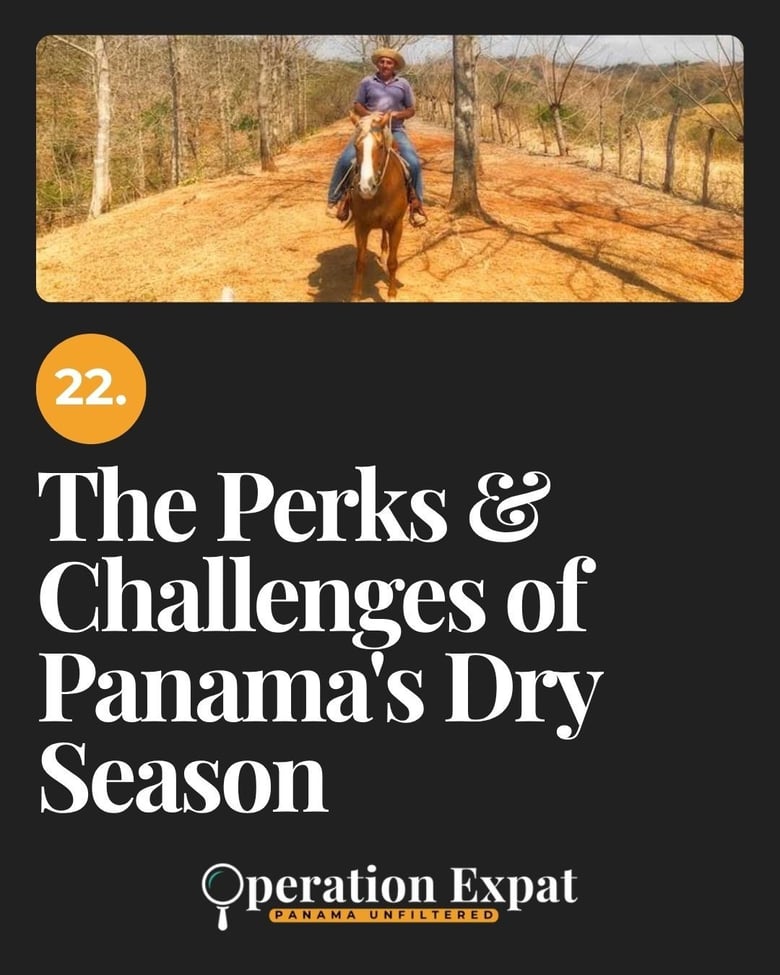
22. The Perks & Challenges of Panama's Dry Season
The Perks & Challenges of Panama's Dry Season
Four months without a drop of rain, relentless winds, and the ancient tradition of fire. A candid look at life in the Azuero's "Dry Arc."
About mid-December, the balmy days of Panama's rainy season give way to the arid dry season. As with most everything in life, the dry season brings both perks and challenges to those who live here.
Having resided on Panama's Azuero Peninsula for the past three years, in the area known as the "Dry Arc," this post is slanted toward the specific conditions here.
Where is the Dry Arc?
Panamá's Dry Arc is located on the Azuero Peninsula along the Pacific Ocean from roughly Pedasí (on the east) to Mariato (on the west).
As the name suggests, this part of Panamá is significantly less humid than the rest of the country. Dryland farming and cattle ranching have thrived for centuries in this region.
Although the vegetation and wildlife here have adapted to typical dry season conditions, humans still run into problems...like running out of water by the end of the season (or earlier in drought years).
We chose to live here as we were apprehensive about the rain being that we had both lived in the "Land of No Rain" (San Diego, California) for more than three decades...and we knew the tropics were no joke.
When is the dry season?
Panama's dry season typically spans from mid-December to mid-April, but the exact dates can vary pretty significantly depending upon whether it's an El Niño or La Niña year.
In the Dry Arc, once the dry season fully kicks in, there is not typically a single drop of rain for many months. All the lush green vegetation dries to a crisp and turns brown and a good portion of the trees lose their leaves.
During El Niño years, warmer ocean temps in the equatorial Pacific trigger drier-than-normal conditions, extending the dry season well into late April, May, sometimes even June.
In contrast, La Niña brings cooler ocean temps resulting in increased rainfall and shorter dry seasons.
I've experienced both El Niño and La Niña in my three years here.
The perks of the dry season...
When the dry season arrives, it offers a long respite from the rains, which many consider a perk. Typically four solid months without a drop.
The lower humidity is also appreciated by many as it reduces the Sweat Factor fairly significantly.
Better surfing conditions are another big perk in our area, which is a popular surf destination.
And, it's safer to swim in the rivers due to the lack of flash floods.
Los Alisios...
Known locally as "Los Alisios," the wind announces the beginning of the dry season.
In the Dry Arc, there is a 180 degree shift in the direction of the wind. In the rainy season, it comes from the ocean (in front of us) and, in the dry season, it comes down off the mountains (behind us).
There is a huge difference in the intensity of the wind between the two seasons as well.
In the rainy season, mild ocean breezes are the most we get; in the dry season, people throughout Panamá have to batten down their hatches.
Wind gusts can get intense...sometimes reaching speeds as high as 65 mph. 😱 If patio furniture and roof tiles aren't totally secure, they are at serious risk of being blown away.
A tradition of fire...
Embedded within the fabric of Panamanian culture is the longstanding tradition of burning the land in the dry season to clear brush and fertilize the soil.
This practice, known as "roza," dates back centuries.
Today, usually in the final month of the dry season, fires burn across the Azuero countryside, casting a warm glow over the mountains, bringing a thick smokey haze to the air, kicking allergies into high gear and, unfortunately, threatening some newer (mostly expat) homes.
While the flames symbolize renewal for most Panamanians, they are dreaded by many expats (including me).
Pretty sure I have SAD...
After three dry seasons here, I'm fairly certain I have the Panamanian version of "Seasonal Affective Disorder (SAD)."
Here is a list of symptoms of SAD:
- Persistent sad, anxious, or "empty" mood most of the day, nearly every day, for at least 2 weeks
- Feelings of hopelessness or pessimism
- Feelings of irritability, frustration, or restlessness
- Feelings of guilt, worthlessness, or helplessness
- Loss of interest or pleasure in hobbies and activities
- Decreased energy, fatigue, or feeling slowed down
- Difficulty concentrating, remembering, or making decisions
- Changes in sleep or appetite or unplanned weight changes
- Physical aches or pains, headaches, cramps, or digestive problems that do not have a clear physical cause and do not go away with treatment
- Thoughts of death or suicide or suicide attempts
Thankfully, I don't have any of the serious symptoms, but I do find that the dry season increases my anxiety, pessimism, irritability, and frustration levels...and decreases my sound sleep.
My desire to go outside also plummets once the winds kick into high gear. It sounds strange, but I swear I feel the suffering of the plants and animals around me.
Plus, many of the local waterfalls either disappear or shrink to a tiny fraction of their usual size.
I've yet to find a place in Panamá where I can escape the wind. At home, not only am I on edge worrying about property damage, but I swear I can feel the plants, trees, and animals struggle.
Thankfully, the rain returns...
As the ashes settle and the rains begin, typically in April or May, new growth emerges and the land quickly reverts to green ~ a testament to the resilience of Panama's natural landscape.
Every year, I'm totally stunned by how fast the landscape gets lush again.
I never would have thought I would be as smitten with the rain as I am. It helps that the temperature doesn't change much. Had I known, I definitely would have considered more areas outside of the Dry Arc.
I haven't given up my search for a windless oasis in Panamá! If you know of one, PLEASE share it in a comment below.
— Operation Expat
Now meet the rainy season
When the rains return, everything changes. Here's my take on the beauty and challenges of Panama's rainy season—the dry season's lush, green counterpart.
Read about the rainy season →Subscribe to the Operation Expat Newsletter so you move to Panama with your eyes wide open! →